27 Jan 2010
Anecdote
A patient had been in the Intensive ward for some time. When her mother came to visit she was delighted to be entertained by her daughter telling her stories of Jack and how despite him not being very clever ended up marrying the princess. It pleased me no end to hear that when I'm not around stories are being used by patients.

21 Dec 2009
News
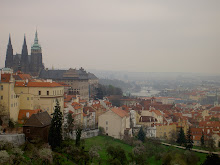
I put a paper forward to deliver a work shop at the 'International Congress for Mental Health Nursing' in Prague. It has been accepted and I am really pleased. Thanks to all those who have offered help and support in preparing the workshop.
11 Dec 2009
Hospital Storytelling Clubs
I'm late writing this up. The reason I think is because I had to spend some time thinking about the two very different experiences I had last Thursday at the two different clubs. I was poorly prepared for the Women's ward. That didn't feel too good. Never-the less I moved the Norse Mythology forward, covering 'The Song of Rig' and 'The Mead of Poetry' which was quite a lot for one session. I am constantly surprise how much the patients engage with the stories and seem to enjoy the more gritty, bawdy parts of the Norse Myths. It was evident that the three patients that attended were actively listening. They all agreed that it would be an idea to find a way of inviting Kvasir on to the ward, they believed he would be a good nurse! We played a game at the end with rhythm, stamping feet and passing a ball around the circle without breaking the rhythm. It didn't quite work but it provided a lot of hilarity and laughter. We talked a bit about what rhythm has to do with stories.
I then went to the Male ward, for which I felt well prepared. I have decided to embark on the Epic 'The King of Ireland Son' by Padraic Colum. I love that story and know it well. I have told parts of it quite a few times and do not believe I will ever tire of it.
But the mood on the ward was very lack luster. The police had been on the ward that day to interview patients about an assault and most of the patients decided not to attend. There were only two. The two that attended were keen, but I could not help feel a little disappointed that more did not attend, even though I say I only need one person to listen. A big difficulty in that session was that a support worker came into the session, which in principle is good, but not if they constantly look at their watch and huff and puff.....very distracting. The patients seemed to listen well, but the support worker was NOT going to get into it. Never mind.
In my roll as a nurse in the hospital I have moved wards. the new ward has only got four patients at the moment. I have told them two stories, in the evenings. Just a couple of simple stories for the un-initiated story listener. But quite a reaction from two of them to the first story I told ('When the Fox and the Squirrel where Friend' Form Daniel Mordens 'Dark Tails from the Woods'). Both of them said they were 'freaked out' they said this in a jokey sort of a way, but talked about the stories quite often after that. Asking questions. Both patients have a history of taking drugs, especially psychedelic drugs. Just wondering if storytelling might tap into some memory of hallucinations from a drug trip? Both patient did listen to the second story I told and listened in an uninterested, macho way!
I then went to the Male ward, for which I felt well prepared. I have decided to embark on the Epic 'The King of Ireland Son' by Padraic Colum. I love that story and know it well. I have told parts of it quite a few times and do not believe I will ever tire of it.
But the mood on the ward was very lack luster. The police had been on the ward that day to interview patients about an assault and most of the patients decided not to attend. There were only two. The two that attended were keen, but I could not help feel a little disappointed that more did not attend, even though I say I only need one person to listen. A big difficulty in that session was that a support worker came into the session, which in principle is good, but not if they constantly look at their watch and huff and puff.....very distracting. The patients seemed to listen well, but the support worker was NOT going to get into it. Never mind.
In my roll as a nurse in the hospital I have moved wards. the new ward has only got four patients at the moment. I have told them two stories, in the evenings. Just a couple of simple stories for the un-initiated story listener. But quite a reaction from two of them to the first story I told ('When the Fox and the Squirrel where Friend' Form Daniel Mordens 'Dark Tails from the Woods'). Both of them said they were 'freaked out' they said this in a jokey sort of a way, but talked about the stories quite often after that. Asking questions. Both patients have a history of taking drugs, especially psychedelic drugs. Just wondering if storytelling might tap into some memory of hallucinations from a drug trip? Both patient did listen to the second story I told and listened in an uninterested, macho way!
11 Nov 2009
Talk at the Wales Millenium Centre
What is the background to traditional storytelling? How do you adapt to different audiences? How do you interpret a story? How do you capture an audience? What are the challenges to bilingual storytelling?
These were the questions put to storytellers Michael Harvey and Guto Dafis at a talk in the Wales Millennium Centre on Monday, which I attended.
The room was set up in a typical lecture style but that was soon changed by the storytelling folk to a semi-circle. The way the listeners and storytellers arrange themselves for a story was discussed and alternatives to the usual cinema style seating arrangements where explored. I had a picture of a pub in Edinburgh called 'The Brass Monkey' that had a room decked with big, sumptuous cushions, you had to scramble in but once you were in and found a place it was comfy. I could imaging it would have been an ideal place for storytelling.
Guto and Michael gave some background information about they came to be storytellers. Always interesting to hear I find.
Guto being a musician talked about setting the atmosphere with music was something he found useful to capture the audience. The eye contact and the connection with the audence/listeners was highlighted by Michael as being an important aspect of storytelling, in contrast to theatre where the audience is usually not seen by the actors.
The challenges of bilingual storytelling is something Michael and Guto have worked with for a long time, the two languages being Welsh and English. It seems to be a process that is difficult to explain to non bilingual people. Quite a creative process, working with the listeners and there responses to the two languages. The talk was scheduled for only an hour, which is not very long. No time to discuss story interpretation.
It was useful for me to go and it gave me plenty of food for thought as I sat on the train back home.
A big thank you to David Ambrose for chairing the talk and also to Michael Harvey and Guto Dafis.
These were the questions put to storytellers Michael Harvey and Guto Dafis at a talk in the Wales Millennium Centre on Monday, which I attended.
The room was set up in a typical lecture style but that was soon changed by the storytelling folk to a semi-circle. The way the listeners and storytellers arrange themselves for a story was discussed and alternatives to the usual cinema style seating arrangements where explored. I had a picture of a pub in Edinburgh called 'The Brass Monkey' that had a room decked with big, sumptuous cushions, you had to scramble in but once you were in and found a place it was comfy. I could imaging it would have been an ideal place for storytelling.
Guto and Michael gave some background information about they came to be storytellers. Always interesting to hear I find.
Guto being a musician talked about setting the atmosphere with music was something he found useful to capture the audience. The eye contact and the connection with the audence/listeners was highlighted by Michael as being an important aspect of storytelling, in contrast to theatre where the audience is usually not seen by the actors.
The challenges of bilingual storytelling is something Michael and Guto have worked with for a long time, the two languages being Welsh and English. It seems to be a process that is difficult to explain to non bilingual people. Quite a creative process, working with the listeners and there responses to the two languages. The talk was scheduled for only an hour, which is not very long. No time to discuss story interpretation.
It was useful for me to go and it gave me plenty of food for thought as I sat on the train back home.
A big thank you to David Ambrose for chairing the talk and also to Michael Harvey and Guto Dafis.
1 Nov 2009
Halloween
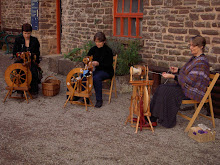
The weather was warm for October, and wind still. That meant that I could tell the story at the Dean Heritage Museum out side and take the listeners for a little promenade too. A big bonus was that two of my spinning friend turned up, so all three of us sat there spinning for a while before the story started. (Look further down the blog for photos)
I still find it a difficult jump to go from spinning to telling, and to continue spinning whilst telling. I wonder if I gesticulate more than necessary? Maybe practicing spinning whilst telling will help me rely less on gesticulation and focus more on the words I choose. That's just a wandering thought.
I enjoyed the setting. Starting the story in one place, then going for a little walk, past the mill, the cider press, the cottage garden and the Foresters cottage, and bringing the story to its conclusion in a different place worked well.
I still find it a difficult jump to go from spinning to telling, and to continue spinning whilst telling. I wonder if I gesticulate more than necessary? Maybe practicing spinning whilst telling will help me rely less on gesticulation and focus more on the words I choose. That's just a wandering thought.
I enjoyed the setting. Starting the story in one place, then going for a little walk, past the mill, the cider press, the cottage garden and the Foresters cottage, and bringing the story to its conclusion in a different place worked well.
29 Oct 2009
Hospital Storytelling Clubs
The last Thursday of the month, means that I do the hospital storytelling clubs. As usual I started on the Women's ward. Due to several patients being ill in bed with possible 'swine flu' there was only two patient attended the group. I continued to tell the Norse Mythology. The Golden Apples of Iduna. Also Odins Sacrifice for Wisdom. Because of the small group it was difficult to do group exercises, it seemed like the critical mass was missing. I was a lot more informal than usual but the two that were there were very good listeners.
After the group I was able to tell a story to two patients on an individual basis in the bedrooms where they were being nursed, these were more of a light heated 'Halloween' type stories.
Then it was over to the male ward. There the biggest group yet attended. Seven in total. I told 'The Boy Who Went to Discover What Fear Was' Quite a lot of spontaneous feed back from the group. Finishing off the group with light hearted Halloween nonsense
After the group I was able to tell a story to two patients on an individual basis in the bedrooms where they were being nursed, these were more of a light heated 'Halloween' type stories.
Then it was over to the male ward. There the biggest group yet attended. Seven in total. I told 'The Boy Who Went to Discover What Fear Was' Quite a lot of spontaneous feed back from the group. Finishing off the group with light hearted Halloween nonsense
23 Oct 2009
More Wheels
The Water Wheel is changing, turning, slowly into my story. I told it again last night to a small group of fellow storytellers. During the day I had been to the Dean Heritage Centre and walked and talked it through again. Thinking about the bits that don't work so well for me and trying different ways of telling it, changing bits to make it more clear to me.
Today, I have just returned home from the Dean Heritage Centre after spending a couple of hours there spinning with my wheel, and visualizing the story in my minds eye. I really enjoyed the atmosphere of the Foresters Cottage. I felt a little out of place sitting there spinning, dressed in my jeans and jumper, as the public drifted by, through the cottage so carefully arranged in an historical fashion.
Next stage, picking out the contrasting moods of the story and clarifying the polarities for myself.
Large piece of paper here I come.
But I must not forget that I have the Hospital Storytelling clubs to prepare for too this week. I think I will be able to use the Water Wheel for one of the wards, but need to focus on the Norse mythology too for the women.
So long till next time.
Today, I have just returned home from the Dean Heritage Centre after spending a couple of hours there spinning with my wheel, and visualizing the story in my minds eye. I really enjoyed the atmosphere of the Foresters Cottage. I felt a little out of place sitting there spinning, dressed in my jeans and jumper, as the public drifted by, through the cottage so carefully arranged in an historical fashion.
Next stage, picking out the contrasting moods of the story and clarifying the polarities for myself.
Large piece of paper here I come.
But I must not forget that I have the Hospital Storytelling clubs to prepare for too this week. I think I will be able to use the Water Wheel for one of the wards, but need to focus on the Norse mythology too for the women.
So long till next time.
Subscribe to:
Posts (Atom)